
Throws and blankets both bring warmth, softness, and texture into the home, but the terms are not always used in the same way. A throw is generally smaller and easier to move, while a blanket is a broader category that can include everything from compact sofa covers to full-size bedding.
The distinction is useful when choosing a product, but it is not absolute. In English retail, throw blanket is a complete and widely used product category. It describes a versatile blanket that can be used on a sofa, chair, or bed for relaxing, layering, and everyday warmth.
Here is how throws, blankets, and throw blankets differ—and how to choose the right one for your home.
What Is a Throw?
A throw is a relatively compact covering intended for flexible, everyday use. Many standard throws measure around 50 × 60 inches, although dimensions vary between products.
Because a throw is smaller than most bed-sized blankets, it is easy to fold, carry, and move between rooms. You might keep one over the arm of a sofa, across the foot of a bed, beside a reading chair, or in a home office.
Throws are commonly used for:
1. Covering your legs while reading or watching television
2. Adding an extra layer during a short nap
3. Bringing color, pattern, or texture into a room
4. Keeping warm in an air-conditioned space
5. Layering over bedding during cooler evenings
Although throws are often used as decorative accents, they are not purely decorative. A well-designed throw should also feel soft, comfortable, and practical enough for regular use.
What Is a Blanket?
A blanket is a broader term for a fabric covering used for warmth, comfort, or bedding. Blankets are available in many sizes, including compact personal blankets and larger Twin, Queen, and King options.
A full-size bed blanket usually provides more coverage than a standard throw and is therefore better suited to overnight sleeping or sharing. It may be used on its own during warmer weather or layered with sheets, quilts, comforters, and duvets during colder seasons.
Blankets also vary widely in material and construction. A lightweight cooling blanket is designed to release heat, while a plush faux-fur or fleece blanket focuses on warmth. Heated blankets offer adjustable warmth, and weighted blankets provide evenly distributed pressure.
For this reason, the word “blanket” alone does not tell you exactly how large, thick, or warm a product will be. The actual dimensions, material, weave, and weight are more useful when comparing options.
Throw vs. Blanket: The Main Differences
Size and coverage
Size is usually the clearest difference.
A throw is generally intended for one person and partial-body coverage. It may cover the lap, shoulders, or lower body while sitting or reclining.
A bed blanket is typically longer and wider, offering more consistent full-body coverage. Some are sized specifically to fit standard mattresses.
You can use a throw while sleeping, but a standard size may not cover a taller adult from shoulders to feet. For regular overnight use, a larger blanket is usually more practical.
Purpose
Throws are designed for flexibility. They can move easily between the sofa, bedroom, reading corner, guest room, and home office. Because they are often left visible, they also play a decorative role.
Blankets are more commonly selected for sleep, full-body warmth, or a particular bed size. However, these uses overlap. An oversized throw can work well for a nap, while an attractive bed blanket can also contribute to the bedroom’s overall style.
Material and warmth
Both throws and blankets can be made from fleece, faux fur, chenille, cotton, knit yarns, or cooling fibers.
A smaller throw is not necessarily lighter or less warm. A dense faux-fur throw may feel warmer than a large, lightweight summer blanket. Warmth depends on the material, thickness, fabric density, and airflow rather than size alone.
Cozy Bliss throw blankets include solid colors, reversible styles, geometric patterns, seasonal motifs, and soft feather-yarn textures, making it easier to choose according to both comfort and interior style.
Portability
A throw is usually easier to fold, store, and carry because of its smaller dimensions. It can remain on a sofa without taking up too much space and is convenient to move whenever you need an extra layer.
A larger blanket offers more coverage but may require more storage space and a larger washing machine.
What Are Throw Blankets Used For?
Everyday sofa comfort
A throw blanket is ideal for reading, watching movies, or relaxing on the sofa. It provides quick warmth without the bulk of full-size bedding.
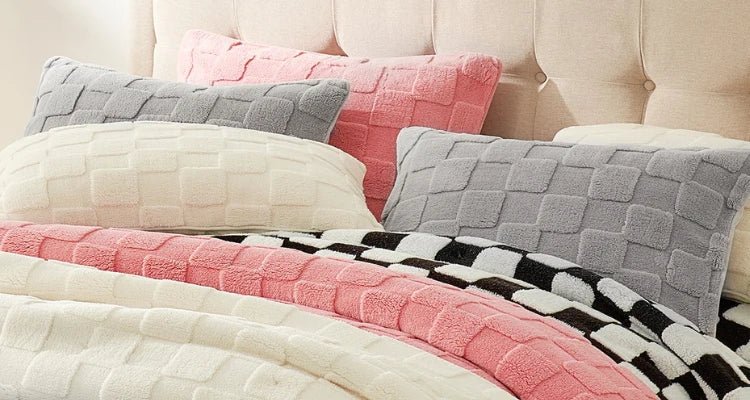
A neutral throw can blend naturally with existing furniture, while a checkered, cherry, shamrock, chevron, or other patterned design can add more personality to the room.
Adding texture and color
Because throws are often left on display, they can become part of the room’s design.
A knit throw adds visible texture to a simple sofa or chair. A colorful design can brighten neutral furniture, while a solid throw can balance a space that already contains patterned cushions or rugs.
For a tidy look, fold the throw over the sofa arm or back. For a more relaxed effect, drape it loosely over one corner.
Layering the bed
A throw blanket is an easy way to refresh a bedroom without replacing the entire bedding set.
It can be folded across the foot of the bed, placed over the lower part of a comforter, or draped diagonally across one corner. The throw then remains within reach whenever your legs or feet need extra warmth.
This is especially useful during spring and fall, when a full winter blanket may feel too heavy, but a sheet alone is not enough.
Reading, working, and short naps
The compact size of a throw makes it useful in reading corners and home offices. It can cover the lap without limiting movement and is easier to adjust than a large bed blanket.
A throw can also be used for a short nap, although an oversized version may be more comfortable for taller users.
Can You Use a Throw as a Blanket?
Yes. A throw can be used as a blanket whenever it provides enough coverage and warmth for the situation.
It works well for sofa lounging, reading, naps, covering the lower body in bed, and adding another layer over existing bedding.
The main limitation is size. A standard 50 × 60-inch throw may not remain over both the shoulders and feet throughout the night. For regular sleep or sharing, a bed-sized blanket usually offers more reliable coverage.
How to Choose the Right Throw or Blanket
Consider where you will use it.
For the living room, choose a throw that is attractive enough to display and durable enough for frequent use.
For the bedroom, decide whether you need a decorative bed-end layer or complete overnight coverage. A throw works well for styling and targeted warmth, while a larger blanket is better for full-body coverage.
Think about the season.
Choose faux fur, fleece, or thicker feather-yarn textures for colder rooms and winter evenings. During warmer months, look for lighter yarns, breathable knits, or cooling fabrics.
A medium-weight throw can be especially useful throughout the year in air-conditioned spaces.
Check the dimensions
Do not assume that every throw has the same measurements. Always review the dimensions before purchasing, especially when choosing an oversized throw or a blanket for a bed.
A standard size is often enough for one person on a sofa. For napping or sharing, a larger option may feel more comfortable.
Choose a material that suits real life.
Consider how the fabric feels, how warm it is, and how often it will need to be washed.
Some people prefer the rich softness of faux fur, while others like the lighter, more flexible feel of a knitted throw. Patterned and reversible designs can also provide more styling options without changing the rest of the room.
Where applicable, the OEKO-TEX® STANDARD 100 label indicates that certified textile components have been tested for harmful substances according to the standard’s requirements.
Follow the care label.
Different materials may require different washing and drying methods. Knitted, faux-fur, cooling, weighted, and heated blankets should not automatically be cared for in the same way.
Always follow the product-specific label to help preserve softness, shape, and appearance over time.
Throw, Blanket, and Throw Blanket: A Simple Summary
A throw is generally smaller, portable, and suited to lounging, layering, and decorating. A blanket is a broader category that includes coverings in many sizes, from compact personal layers to full-size bedding.
The terms are not opposites. A throw is itself a type of blanket.
In English retail language, throw blanket is a complete and common product category. It usually refers to a versatile blanket that is smaller than traditional bed-sized bedding but still practical for warmth, sofa use, naps, reading, and bedroom layering.
That is why Cozy Bliss products can correctly be called throw blankets: they combine the flexibility and visual appeal of a throw with the softness and everyday comfort expected from a blanket.
Frequently Asked Questions
What is the difference between a throw and a blanket?
A throw is usually smaller and easier to move, while a blanket is a broader term that also includes larger products designed for beds and full-body coverage.
What does “throw blanket” mean?
A throw blanket is a common retail term for a compact, versatile blanket used on sofas, chairs, and beds for warmth, relaxation, and decoration.
What is a standard throw blanket size?
A common size is approximately 50 × 60 inches, although dimensions vary. Oversized throws provide more coverage for naps and taller users.
Can a throw blanket be used on a bed?
Yes. It can be placed across the foot of the bed, layered over a comforter, or used for extra warmth. A larger blanket is more suitable when complete overnight coverage is needed.
How should I choose a throw blanket?
Consider the size, material, warmth, season, design, and care instructions. Choose a style that works with both your room and the way you plan to use it.


Hinterlasse einen Kommentar
Diese Website ist durch hCaptcha geschützt und es gelten die allgemeinen Geschäftsbedingungen und Datenschutzbestimmungen von hCaptcha.